5 Things Every Designer Should Ask Themselves in a Circular Economy
Sarah Krasley, sustainable manufacturing lead at Autodesk, pens a story for us on 5 things every designer should ask themselves in a circular economy.
The first hour of almost every sustainability-related conference begins with someone posing the question, “So, how exactly are we defining the word ‘sustainability’?”
The Brundtland Commission definition gets trotted out first, followed shortly by The Triple Bottom Line, and sometimes, if I’m lucky, my personal favorite is mentioned, Buckminster Fuller’s “To make the world work for 100 percent of humanity in the shortest possible time through spontaneous cooperation without ecological damage or disadvantage to anyone.”
This prelude to the first conference panel or speaker is normally the time I go refresh my coffee and stop listening, but an interesting new framing of sustainability has joined the party and has made me stay put in my seat.
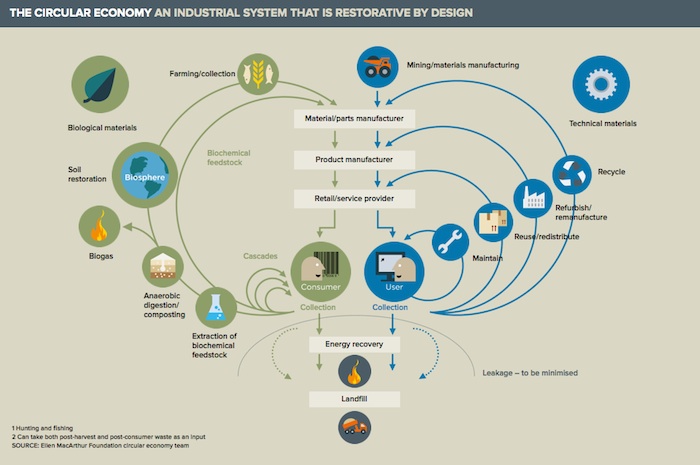
The Circular Economy is a new framework from the Ellen MacArthur Foundation for the creation, manufacture, use, and reclaiming of goods in society. The basic idea is that we are currently operating in a very linear way - we harvest crops or extract resources from the ground, we transport those materials to a place where they can be processed into yarn or a particular shape (like a block or sheet), we transport it again and process it a little more and attach it to other materials and motors and wires, we sell it to consumers, they use it, and in some cases it is so lovely and durable that it is passed down through generations (either within a family or through second-hand shops), or it is recycled (with sometimes pretty lousy recovery rates), ends up in a landfill forever, or it gets incinerated.
The Ellen Macarthur Foundation is advocating that we move to a more circular way of doing things.
The most ubiquitous example of how this might work is the example of a washing machine.
Why on Earth are washing machines still sold and not rented? If they were rented, the manufacturer could have control over the whole lifecycle of the product: they could recover it and use the parts for a new washing machine at the end of its life, they would be right there when the customer is ready for a new rental, they could offer maintenance and service and could prove themselves as an awesome company from whom to rent, etc.
In addition to the benefits to the customer and the manufacturer, this model rewards the environment and society: a machine that’s rented has built in maintenance and will be kept in good working order. When machines are sick, they use much more energy to do what we want them to. Keeping a machine in good working order means it will be more prone to use water and electricity more efficiently. Lastly, if we add a technology layer to this scenario, (and because I am a technologist, I just can’t resist doing that), the washing machine would likely be connected to the customer’s wifi network and to the internet. It could send information back to the manufacturer about its performance and could schedule maintenance when something is wrong, it could hook into smart grid data and wash clothes at the moments when electricity and water demand is at their lowest points (and cheapest price).
While a washing machine is a dear friend to those in fashion, how could the circular economy principles work for a fashion line?
Recently, GreenBiz ran an article about fashion brands adopting the Circular Economy. The article quotes Peter Lacy, Managing Director of Accenture Strategy for the Asia Pacific region. Lacy lists out five circular business models he’s seeing employed by apparel companies.
Here are his views with some ideas from me on how they could be explored in a fashion business. I encourage the entrepreneurs reading this to explore one or two of these elements in your business plan and for more established companies to use these as brainstorming prompts for new business directions or design elements.
1. Circular inputs: new ways of thinking about the inputs and the raw materials.
Can you utilize recycled fabrics? Can you trace back all the materials in your garment to their origin points? Are there things you can do collaboratively with the folks in your supply chain to overcome obstacles to more sustainable designs?
2. Output recovery: recovering useful resources from products that are discarded.
Can you implement a garment take-back program? What would that look like?
3. Product life extension: elongating the useful life of products and services.
Can the pieces change with the person as they age? Can you experiment with ways to make your garments as durable and timeless as possible so the user keeps them for a long time?
4. Sharing platform: opening up new ways of sharing and harnessing technology to use assets more effectively.
This one could have implications on the transaction side but also on the manufacturing and production side. Can you work with other brands to share resources or space? Is there a way for your clothes to harness solar power or extend a wearable technology experience that impacts the wearer or society in a positive way?
5. Product as a service: a shift from products to services and from consumer-based models to user-based models.
Can you experiment with renting models in lieu of customers buying your pieces outright?
As senior sustainable manufacturing lead at Autodesk, Sarah Krasley is responsible for developing tools for manufacturers to create more sustainable product and factory designs. Outside Autodesk, she consults on sustainable labor projects and contributes articles to FastCoExist, Al Jazeera America, and GreenBiz. She has more than a decade of experience working in the convergence of business, design, and sustainability. She holds a bachelors’ degree in design from the Pratt Institute and a masters of business administration degree from the University of San Francisco.
Image: Brad Perkins, Cameron Adams